Before the Tour de France begins, a communication window opens. This article documents how five professional cycling teams used that window in 2026 — and what their choices reveal about Tour de France team communication as a strategic asset. The examples are drawn from direct observation of team channels and primary sources between early June and 24 June 2026, before most teams had published their final rosters.
The weeks before the Tour are a marketing moment. Teams are starting to notice.
The Grand Départ creates attention. Not just on race day — in the weeks before it. Media coverage builds. Sponsors look for moments. Fans start paying attention earlier than usual. The Tour de France generates over a billion live TV broadcast Tour de France media reach annually. For a brief period, professional cycling occupies more space in the broader sports media landscape than at almost any other point in the year.
That window has value. What teams do with it varies enormously.
This is a snapshot taken on 24 June — ten days before the start in Barcelona. Many teams had not yet published their final rosters. The team presentation in Barcelona was still ahead. More creative pre-race content will follow from teams across the peloton, as it does every year in the final days before the Grand Départ. What this article captures is an early read: five teams that moved deliberately, before most of the field had started communicating at all.
This is not a ranking. It is a record of five different approaches, and what each one reveals about how teams think — or do not think — about Tour de France team communication as something worth designing.

From announcement to content machine: a shift that is still in progress
For most of professional cycling’s history, the pre-Tour announcement was a transaction. A team published its roster. Journalists picked it up. Fans noted it. That was the communication.
That model still exists. Plenty of teams will send a press release with eight names and call it done. But something is shifting at the more intentional end of the field. A growing number of teams are treating the pre-race period not as a moment to discharge an obligation, but as a content opportunity in its own right — one with its own audience, its own formats, and its own sponsor value.
The shift is from announcement to content machine. Instead of a single release that delivers information, teams are building sequences: multiple pieces, multiple formats, multiple touchpoints across several weeks. Each piece does a different job. Together they generate sustained visibility in a window when attention is high and competition for it is still relatively low.
At the far end of that spectrum sits Visma | Lease a Bike in 2026 — jersey voting that ran for weeks and drew over 100,000 participation actions, followed by a YouTube live show co-presented with their title sponsor. That is currently the most developed version of what pre-Tour team communication can look like. Most teams are nowhere near it. But it marks the direction.
This is not yet the norm. It may not be the norm for a while. But the direction is clear, and the teams that have moved in that direction are already operating on a different level — not just in reach, but in how they are perceived by sponsors, media, and the wider sports marketing industry.
The five examples below sit at different points on that spectrum.
Visma | Lease a Bike: Building a participation system, not a campaign
The most structurally sophisticated pre-Tour communication this year came from Visma | Lease a Bike. The team did not launch a jersey. They built a system around it.
The sequence ran across several weeks. It started with a fan jersey vote — a mechanism that generated more than 100,000 participation actions. The 2026 Tour de France jersey itself was the product of that vote: two design options, fans decided, the narrower winner became the race kit and the losing design went into commercial release. That number matters beyond the engagement itself. It is a demonstrable audience scale figure. It is the kind of metric that goes into sponsor conversations.
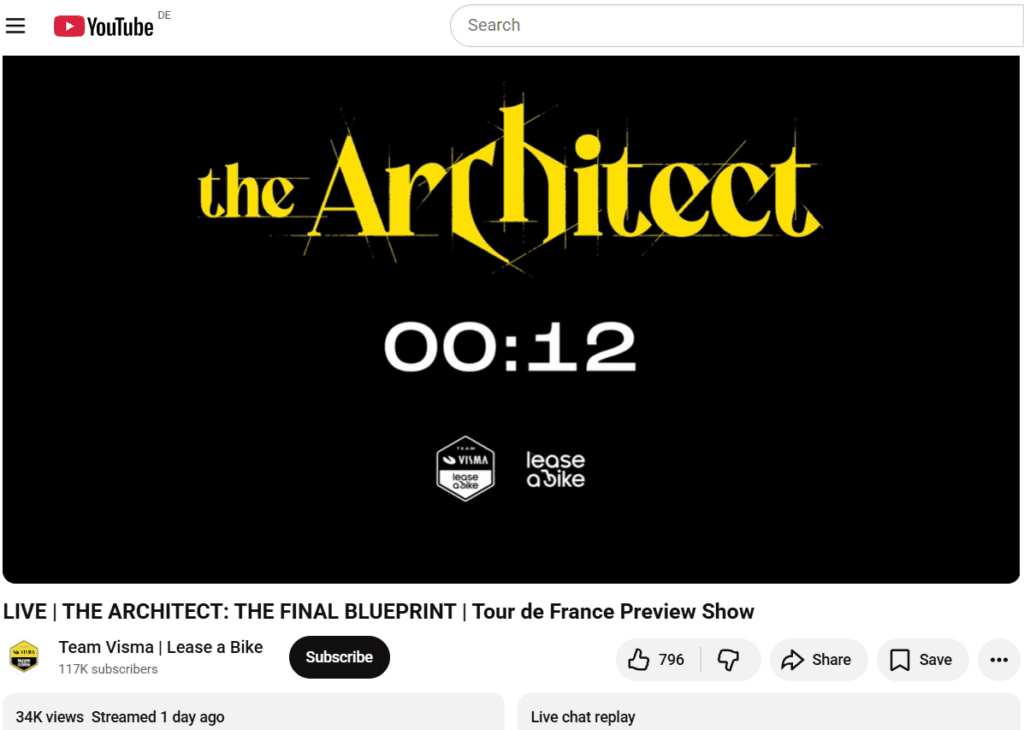
The sequence ended with a YouTube live show on 23 June, co-presented with title sponsor Lease a Bike. During the broadcast, new sponsor integrations were revealed on race kit — logos appearing on socks and gloves for the first time. The reveal happened live, in front of an engaged audience, with the title sponsor co-presenting.
Each element serves a different function. The vote builds reach organically. The live show gives sponsors a broadcast moment with real viewers. The kit reveal inside that broadcast makes sponsor visibility feel like an event rather than an announcement.
What makes this additionally interesting: Visma | Lease a Bike is currently in the market for a new title sponsor. The Tour de France is the most valuable showcase window in the sport. Building the most sophisticated pre-race communication campaign in the peloton, at precisely this moment, is not incidental. A team demonstrating 100,000 fan participation actions and a live sponsor broadcast ahead of the biggest race of the year is a team making an argument about its own market value.
Taken together, this is not a campaign in the traditional sense. It is a participation architecture. The pre-Tour window becomes a structure with multiple entry points, measurable outputs, and sponsor value built in at each stage. This is what the content machine looks like when a team has both the resources and the strategic reasons to build one.
Movistar: Turning the Grand Départ host city into the jersey itself
Movistar Team marked the Barcelona start with its own special edition kit, also drawing on Gaudí and the city’s architecture.
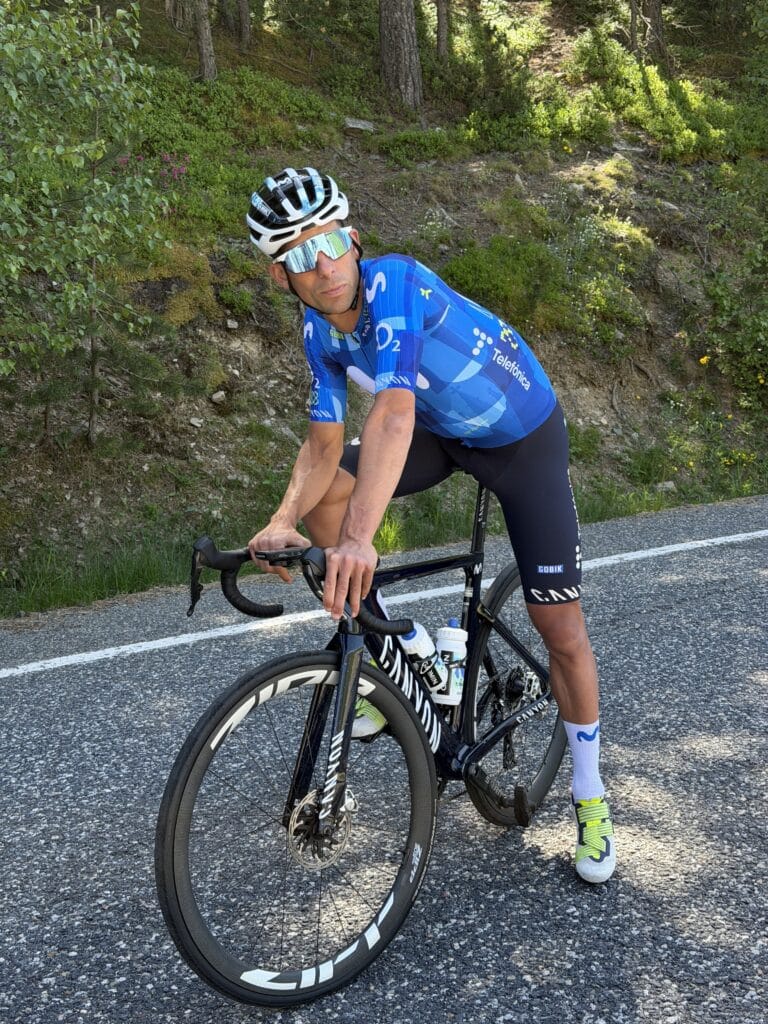
On 29 June, five days before the start in Barcelona, Movistar presented a special edition kit inspired by the shapes, textures and geometries of the Sagrada Família. The team describes it as a tribute to Barcelona, Antoni Gaudí and the Sagrada Família, marking the centenary of Gaudí’s death.
Image: Movistar Team
As the only Spanish team in the UCI WorldTour, Movistar frames the Barcelona Grand Départ as a particularly meaningful moment for Spanish cycling.
In its own framing, the jersey is meant to carry the values Movistar associates with Gaudí’s work — creativity, innovation and the pursuit of excellence — values the team positions as part of its own identity as well.
Caja Rural–Seguros RGA: Returning to a race you haven’t started in 37 years
Caja Rural–Seguros RGA is a Spanish ProTeam — not a WorldTour squad. Their place on the 2026 start list comes via wild card invitation, not automatic qualification. And they will race the Tour de France for the first time since 1989. That fact is the communication. The team understood that, and used it.
On 2 June, the team held a physical launch event in Pamplona. The occasion was a race-exclusive jersey — a kit designed only for the Tour, referencing the team’s design language from the 1980s. Marino Lejarreta was present. The Basque climber who represented the team in those original Tour starts is now 69 years old. He stood in the room alongside current riders Abel Balderstone and Fernando Gaviria.
The format requires almost no explanation. A living connection to the team’s Tour history, wearing the same colours, at the launch of a kit that will only ever be worn at this race. The story is in the room.
The team’s communications also carry the hashtag #ForçaJaume — a reference to teammate Jaume Guardeño, who suffered serious injuries in a training accident in March and is currently in neurological rehabilitation. That element adds human weight to the campaign without overriding it. It is present without being made the centrepiece.
Team president Floren Esquisábel described the Tour start as recognition of years of sustained results. The framing is accurate. And the pre-Tour communication reflects that arc: restrained, earned, built around something real.
Uno-X Mobility: Giving the roster announcement a concept
On 23 June, Uno-X Mobility published a team announcement on their website. The piece runs through the full lineup with individual rider descriptions and extended quotes from Sports Director Gabriel Rasch. What makes it editorially interesting is the frame around it.
The team introduced an internal concept for this Tour: “Union-X.” The reference is historical — Denmark and Norway once shared a union. The team, built around riders from both nations, positions that bond as the conceptual foundation of this year’s Tour roster.
It is a light touch. The concept does not change what the team is. But as the team puts it themselves, it is a reminder of who they are: a Danish-Norwegian project with riders from both nations, built on the same culture, the same ambitions, and the same willingness to take on the biggest races together.
What the “Union-X” framing ultimately does is turn a press release into a narrative. The roster announcement becomes a story about identity and shared ambition — one that travels further than a list of eight names ever would on its own.
Red Bull–BORA–hansgrohe: Using an existing media universe
On 17 June, Red Bull–BORA–hansgrohe published a double profile of Remco Evenepoel and Florian Lipowitz on redbull.com. The piece is built around their first joint training ride on Mount Teide in late February — two very different riders, one shared ambition. It is a preview of the full feature running in The Red Bulletin, Red Bull’s own editorial magazine.
Red Bull operates one of the most developed content ecosystems in professional sport — spanning a global website, an international magazine, and the team’s own publishing surfaces. A pre-Tour rider profile can move across all of them, reaching audiences far beyond the cycling world at each step.
That is what happened here. The piece ran in mid-June, weeks before the start. The Red Bulletin is distributed across multiple markets internationally, with a readership well beyond sport, spanning culture, music, and adventure. A Tour de France team profile inside that magazine is not cycling content. It is Red Bull content, with cycling at the centre. For Red Bull–BORA–hansgrohe, that is the natural place to present their strongest Tour de France lineup yet — not in the cycling press, but in the universe where Red Bull defines what high performance looks like.
Bahrain Victorious: Sponsorship news in Tour context
In the weeks before the Tour, Bahrain Victorious published a sponsorship announcement — involving locations in the French Alps. Not a team reveal, but a smart moment to announce new partnerships that land squarely in Tour de France territory.
In the announcement the team has shared a training camp agreement with Serre-Chevalier Briançon — a region that includes the Galibier, the Granon, and the Izoard, all of which appear on the 2026 Tour route. The camp runs from 10 to 24 July, with a programme of public activations planned alongside the training: meet-and-greets, signing sessions, and time with the local cycling club.
This is not a team announcement. It is sponsorship communication, of the kind teams publish throughout the season. What makes it an interesting constellation ahead of the Tour is the combination: Alpine locations with direct relevance to the race route, a training camp timed during the race itself, and community activations built around it — without a single squad reveal post.
What the window shows — and what is still to come
These five examples were captured on 24 June, ten days before the Grand Départ in Barcelona. Many teams had not yet published their final rosters. The team presentation was still ahead.
What the snapshot shows is a range. Visma built a multi-week participation system with sponsor integration at every stage. Caja Rural activated a return story through physical presence and historical memory. Uno-X turned a roster announcement into a narrative about identity. Red Bull–BORA placed their key riders inside a content universe that reaches well beyond cycling. Bahrain Victorious published sponsorship news — two Alpine location partnerships with direct relevance to the Tour route, a training camp timed during the race, and community activations planned around it. Not a team reveal, but a notable constellation.
The shift from announcement to content machine is real, and it is still in progress. Some teams are already designing the pre-race window deliberately. Others will announce their squads in the coming days and move on. A few will do something unexpected between now and Barcelona.
We are watching to see how the rest of the field communicates. For the full picture of who is sponsoring at the 2026 Tour, see the Tour de France sponsors.
For the full commercial picture of who is riding and why teams carry these names, see the Tour de France 2026 team and sponsor overview.
Sources:
https://www.unoxteam.com/news/this-is-our-team-for-tour-de-france
https://www.redbull.com/int-en/evenepoel-lipowitz-tour-de-france-partnership

Working in cycling sponsorship, marketing or media?
Get the pro cycling commercial recap.
Curated insights on sponsorship, marketing and commercial developments in professional cycling.
No noise. One recap. Every month. Unsubscribe anytime.
Lates Instagram posts